Danny Hatters laboratory
-
Head of Laboratory

Professor Danny Hatters+61 3 8344 2530
Research Overview
Research in the Hatters lab is focused on understanding the molecular mechanisms underpinning neurodegenerative diseases involving protein misfolding and aggregation. This primarily includes Huntington’s and Motor Neuron Diseases. Our efforts involve building new biosensors and methods to track the misfolded and aggregated states of proteins in cells and using these approaches to determine how they interact with the cellular machinery to propagate dysfunction or trigger adaptive responses to stress. Other related areas of research include defining the latent efficiency of cells to manage folding of the proteome.
Our approach is to apply multidisciplinary methods to understand disease mechanisms including proteomics, transcriptomics, computational modeling, cell biology and imaging, and protein biochemistry.
Staff
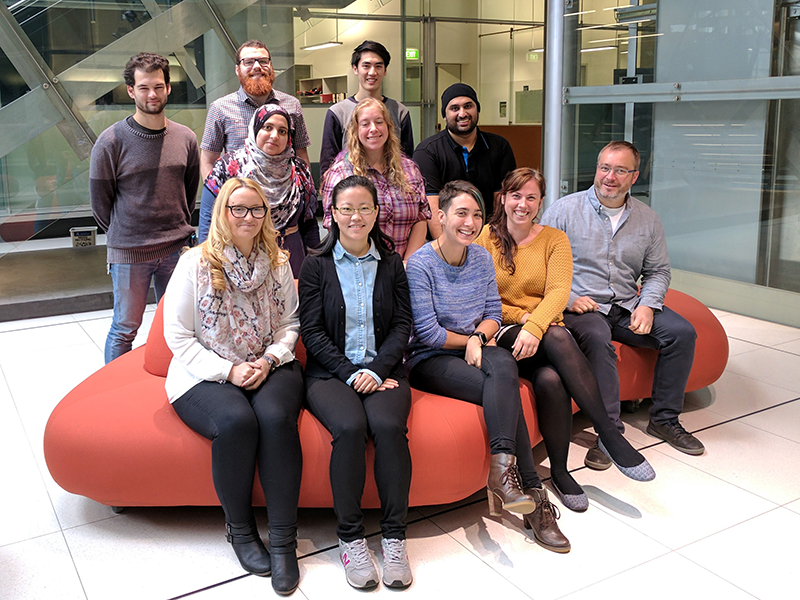
Dr Dezerae Cox, Post doctoral fellow
Ms Angelique Ormsby, Research Assistant
Ms Autumn Bricker, PhD Student
Mr Nagaraj Moily, PhD Student
Ms Mona Radwan, PhD Student
Ms Xiaojing Sui, PhD Student
Mr Mikhail Trubetskov, PhD Student
Ms Candice Raeburn, PhD Student
Mr James Daly, Honours Student
Mr Robert Naturani, Honours Student
Mr Stanley Teo, Honours Student
Collaborators
Associate Professor Alicia Oshlack, Murdoch Children’s Research Institute
Professor Paul Gooley, Department of Biochemistry and Molecular Biology, The University of Melbourne
Dr Yuning Hong, La Trobe University
Professor Paul Gleeson, Department of Biochemistry and Molecular Biology, The University of Melbourne
Dr Till Böcking, University of New South Wales
Associate Professor Alex Dickson, Michigan State University
Dr Justin Yerbury, University of Wollongong
Dr Simon Ebbinghaus, Ruhr University Bochum, Germany
Dr Hannah Nicholas, University of Sydney
Professor Anthony Hannan, Florey Neurosciences Institute, The University of Melbourne
Professor Gavin Reid, Department of Biochemistry and Molecular Biology, The University of Melbourne
Funding
NHMRC Project Grant: "Pathogenic and adaptive molecular interactions with mutant huntingtin exon 1."
NHMRC Project Grant: "Dissecting polyQ - ataxin -1 trafficking and nuclear body dynamics as drivers of toxicity."
ARC Discovery Grant: "Surveillance of the mechanisms controlling proteome foldedness."
Human Frontier Science Program, Research Grant: "Defining the capacity of cells to keep the proteome folded over space and time."
Research Publications
Click here for the results of a PubMed search of Danny's publications.
Click here for the results of a Google Scholar analysis of Danny's publications.
- Ramdzan YM, Trubetskov MM, Ormsby AR, Newcombe EA, Sui X, Tobin MJ, Bongiovanni MN, Gras SL, Dewson G, Miller JML, Finkbeiner S, Moily NS, Niclis J, Parish CL, Purcell AW, Baker MJ, Wilce JA, Waris S, Stojanovski D, Bocking T, Ang CS, Ascher DB, Reid GE, Hatters DM. Huntingtin inclusions trigger cellular quiescence, deactivate apoptosis, and lead to delayed necrosis. Cell Rep 2017; 19(5): 919-927.
- Radwan M, Wood RJ, Sui X, Hatters DM. When proteostasis goes bad: Protein aggregation in the cell. IUBMB Life 2017; 69(2): 49-54.
- Hatters DM. Protein folding: Illuminating chaperone activity. Nat Chem Biol 2017; 13(4): 346-347.
- Polling S, Ormsby AR, Wood RJ, Lee K, Shoubridge C, Hughes JN, Thomas PQ, Griffin MD, Hill AF, Bowden Q, Bocking T, Hatters DM. Polyalanine expansions drive a shift into alpha-helical clusters without amyloid-fibril formation. Nat Struct Mol Biol 2015; 22(12): 1008-1015.
- Polling S, Mok YF, Ramdzan YM, Turner BJ, Yerbury JJ, Hill AF, Hatters DM. Misfolded polyglutamine, polyalanine, and superoxide dismutase 1 aggregate via distinct pathways in the cell. J. Biol Chem 2014; 289(10): 6669-6680.
- Ormsby AR, Ramdzan YM, Mok YF, Jovanoski KD, Hatters DM. A Platform to View Huntingtin Exon 1 Aggregation flux in the cell reveals divergent influences from chaperones hsp40 and hsp70. J Biol Chem 2013; 288(52): 37192-37203.
- Ramdzan YM, Polling S, Chia CP, Ng IH, Ormsby AR, Croft NP, Purcell AW, Bogoyevitch MA, Ng DC, Gleeson PA, Hatters DM. Tracking protein aggregation and mislocalization in cells with flow cytometry. Nat Methods 2012; 9(5): 467-470.
- Miller J, Arrasate M, Brooks E, Libeu CP, Legleiter J, Hatters D, Curtis J, Cheung K, Krishnan P, Mitra S, Widjaja K, Shaby BA, Lotz GP, Newhouse Y, Mitchell EJ, Osmand A, Gray M, Thulasiramin V, Saudou F, Segal M, Yang XW, Masliah E, Thompson LM, Muchowski PJ, Weisgraber KH, Finkbeiner S. Identifying polyglutamine protein species in situ that best predict neurodegeneration. Nat Chem Biol 2011; 7(12): 925-934.
- Ramdzan YM, Nisbet RM, Miller J, Finkbeiner S, Hill AF, Hatters DM. Conformation sensors that distinguish monomeric proteins from oligomers in live cells. Chem Biol 2010; 17(4): 371-379.
- Olshina MA, Angley LM, Ramdzan YM, Tang J, Bailey MF, Hill AF, Hatters DM. Tracking mutant Huntingtin aggregation kinetics in cells reveals three major populations that include an invariant oligomer pool. J Biol Chem 2010; 285(28): 21807-21816.